Airline pilot interviews: how to prepare for the assessment day
- updated on August 20, 2026
A note before we start. This article was originally written for the French selections, where the interview stage is known as psy2 and where the two big recruiters are Air France and the ENAC-EPL competitive exam. We have kept those examples, because that is where our first-hand material comes from. The format itself travels: a group exercise under time pressure, a one-to-one interview, a self-critique question and a scoring grid are what you will meet at almost every airline and every cadet programme in the world. Change the names and the picture holds.
The interview stage covers the spoken psychological assessments, both group and individual, that a candidate faces during an airline selection or a cadet programme. Between one recruiter and the next the differences are small: the format is broadly identical, and what is expected of you as a person does not change.
Why prepare at all?
The question we are asked is always the same: should you prepare for the interview stage, and if so, how? Plenty of people will tell you to just be yourself, stay relaxed and give your best. That advice is hollow. What these interviews are looking for is unusual, and most candidates have no idea what it is. It would be a shame to be eliminated on a point you could easily have corrected, if only you had known.
Unlike the first aptitude screening and the full aptitude test day, which you can practise from end to end on Pilotest, the interview stage calls for preparation that reproduces the format of the day and gives you a debrief on how you came across.
Preparing means putting yourself in front of people who have actually recruited for an airline. They see what you cannot. You could also learn by trial and error, by sitting the interviews more than once and asking for feedback, but attempts are few and expensive, so a mock interview makes sense. Preparing is not about learning tricks. It is about becoming aware of the image you project and of the doubts you may raise in a recruiter's mind, so that you can correct them. It is also about putting into perspective the things that worry you, because they are not necessarily what your recruiter will pick up on.
Where should you prepare, then? Pilotest has no recommendation to make on that point. Ask around among pilots who have recently been through the selection you are sitting, and be wary of the dream merchants who claim to prepare candidates for interviews without ever having sat on a selection board themselves.
What the format looks like
First, short debates
The format barely varies. Each candidate first chairs a short debate on a topical subject, usually phrased as a question. Ten minutes to get the group talking, pull the threads together and conclude. What is being judged here is your social ease, your empathy, your ability to listen, and how well you organise the discussion.
Then the group exercise
Next comes the group exercise: a puzzle to solve collectively in thirty to forty minutes, tick tock, tick tock. A great deal of numerical data. Each participant holds different data, which forces a pooling phase. A typical brief runs something like this: "there are N of you on a desert island. You have two rafts and supplies for X person-days. You must rescue another group of M people who are Y hours' walk away, and get off the island before the bomb goes off in Z hours." The real brief is far more involved and runs to a good page per person. Expect to be interrupted after twenty minutes by an examiner handing you fresh information or new constraints.
Let us be clear: it is not built to be solved. Do your best to move the group towards a solution while pretending not to notice that there may not be one. A few minutes before time, one of the candidates sums up the group's work. If that is you, be honest and factual. Report without embellishment. State the limits of your solution and the criteria from the brief that you have not checked. Respect the timing to the letter. And that is it, done.
An assessment under stress
Why that particular exercise, you might ask, rather than a fishing contest or a recorder recital? The point is to watch how you perform under TIME PRESSURE, doing GROUP WORK, with a strong NUMERICAL component. You can see where this is going: it has a great deal in common with a cockpit. That format was chosen because it simulates those three things at minimal cost.
A short note on stress. Stress is cumulative. Picture a jar that fills up through the ordinary events of your life. Everything goes in: your emotional state, how work is going, yesterday's row at home, the two hundred euros you are overdrawn. Anything will do, and stress does not sort the important from the trivial. Not all of it is bad, mind you. Up to a point it is good for motivation. Beyond that point, if the jar keeps filling, it overflows and everything collapses with it. Your capacities drop sharply. Everyone is different, both in how full the jar already is and in how much it holds.
Stress can also be anticipated and tamed. Everyone has their own method. Some people are barely affected to begin with. Others do yoga, others sport. Hard physical exercise releases endorphins for twenty-four to thirty-six hours, a powerful anti-stress agent with no side effects. Medication exists, but its side effects have no place in aviation.
At the interview stage they will fill your jar and watch what happens. It is a remarkably good predictor of what you will be worth in a cockpit. Can you still deal with people? Still handle numbers? Still see the whole picture? Still listen to others? Still be resourceful? Still follow the rules? Or do you narrow down and lock onto two per cent of what is going on?
Your true nature always comes back under stress, and it comes back fast.
Criticising yourself
Part of it is a classic interview
Now for the individual interviews. Your background, your motivation, why you want to fly, why you want to fly for this airline. Those you can prepare. Revisit what has driven you over the long run: flying or aviation experience, the moments that stayed with you. What will you do if we turn you down? And why an airline pilot in particular, when there are plenty of other flying jobs? Why not the military, then? You do not like being told what to do, is that it? So far this is a standard recruitment interview. Depending on who is sitting across the table it may or may not feel like a rodeo, but the atmosphere of the interview tells you nothing about how your application is being received. Do not be thrown if they dig: they are simply clearing up grey areas.
Then the self-critique
Then, without fail, comes the question: "and what did you make of the group exercises?" Read that as: what do you regret, and what would you do better if you started again?
Your fate hangs on the answer. Why? You can mention the positives briefly, but what is really wanted is a SELF-CRITIQUE that is CONSTRUCTIVE and RELEVANT. This is how your recruiter tests your capacity to question yourself, and your humility. And there is bound to be something to criticise, because your group necessarily made a mess of that fiendish puzzle. Which means you, personally, could have done better.
What has that got to do with flying?
You are applying for a job in which your position is questioned again and again. Demanding ab initio training, six-monthly simulator checks, a new type rating, a medical problem, new SOPs to absorb. A pilot spends their working life either following procedures or having to take new ones on board quickly. Being slow or reluctant about it is a cost to your airline, and potentially a danger. So they need to be sure you learn quickly, and with a degree of autonomy. Above all, they need to know that you can spot and correct your own departures from what is expected, even when what is expected has not been spelled out in full.
That is exactly what cadet training or a type rating feels like. A briefing packed with information and instructions to comply with. Off you go, flying or in the sim. It costs a fortune an hour. Almost all of it has to be right first time. You come back and debrief. On the few per cent that need rework, you have to be capable of diagnosing yourself, or at the very least of taking your instructor's criticism with complete humility. By the next flight or the next sim session, whatever was wrong must have been fixed. That is what is expected of you, and it is why this interview stage exists: to find out whether you can hold a steady, positive learning curve by learning from your own mistakes.
In the 1960s, ab initio cadets were trained over three years and five hundred flying hours. A pilot had time to learn, and fuel cost next to nothing. That world is gone. Today a cadet reaches the type rating with a hundred and eighty flying hours, soaking wet. As the saying goes, it stings.
The view from the recruiter's chair
Type 1 and type 2 errors
Your recruiter is working under tight economic constraints, and is more or less open to risk depending on how badly pilots are needed at that moment. An airline invests heavily in every pilot it hires, so statistically it wants to limit failures in training or on the line. The risk a recruiter accepts translates into a ceiling on type 1 errors (E1). E1 covers the pilots who are hired and subsequently fail, and therefore cost the company money. A type 2 error (E2), by contrast, is the candidate who is turned away but would have made a good pilot: the human collateral of the selection process.
Statistically, E1 × E2 stays above a given bound (B). Open the gates and take everybody, and E2 falls while E1 rises. Tighten the sieve and E1 falls while E2 rises. The target for an airline cadet programme is typically E1 below 2%.
So the recruiter's whole game is to find a testing process, in other words a selection model, that pushes B down as far as possible, in order to lower E1 without pushing E2 up too far.
Raise no doubts
A selection is therefore recruitment by elimination. Unlike the competitive exams where you have to be the best, a selection works by ruling out certain human characteristics. So even when the odds end up as long as those of the most selective universities, the mechanics are disconcerting for anyone conditioned by the competitive-exam mindset. It is no longer about beating the others on a weighted average. It is about not being eliminated on any one of the many criteria being watched. A good pilot is very normal, but normal across the board, which is statistically about as rare as a gift for mathematics. You are not there to score points. Your application simply has to raise no doubt about your ability to get through training and build a career with the airline.
What the scoring grid looks like
Here is what a typical interview assessment sheet looks like. We comment on the individual items below.
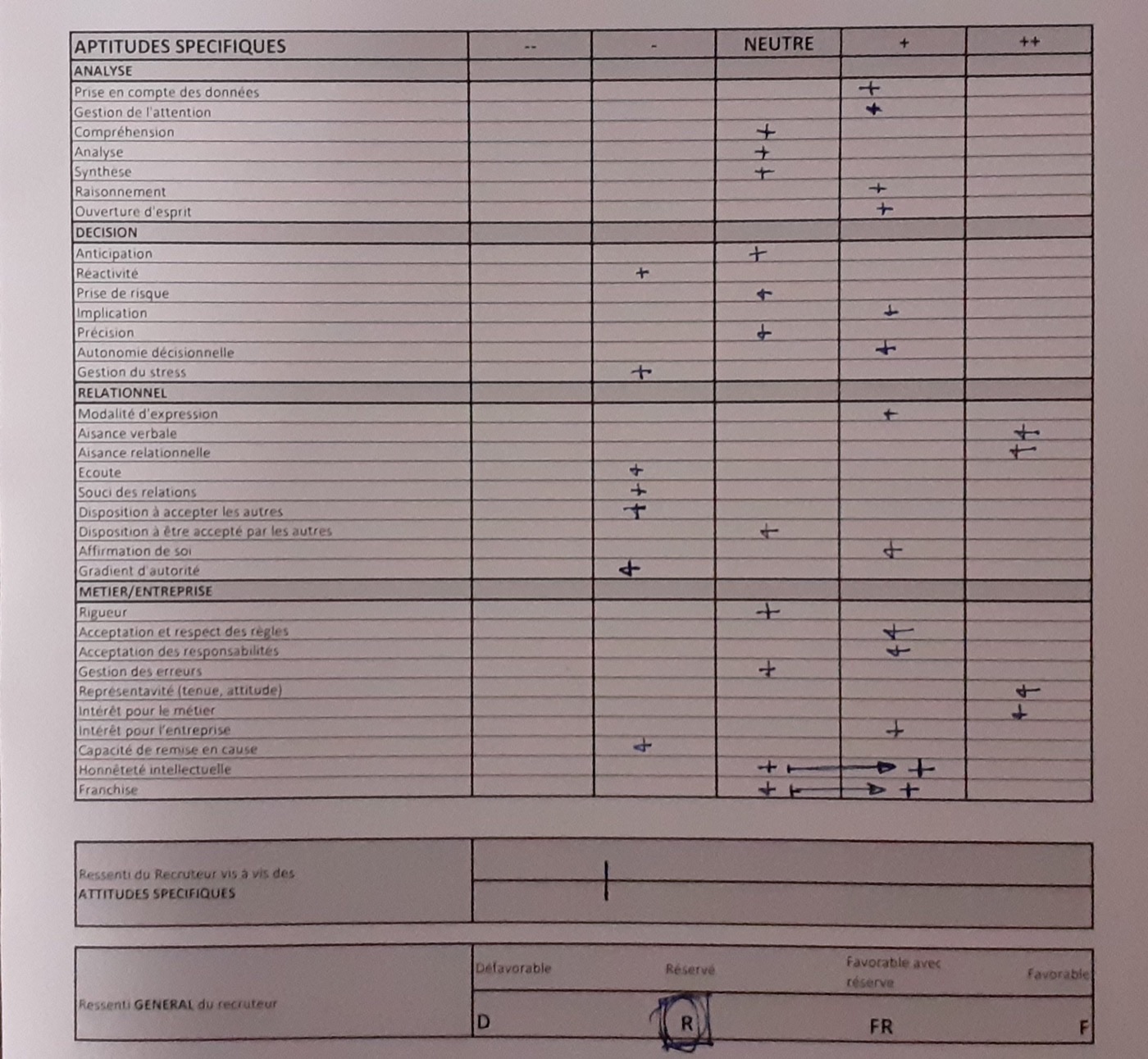
ANALYSIS
Taking in the data: can you stack all the numbers in your head, yours and the other candidates', or does it overflow and start dropping out?
Managing attention: do you stay at the heart of the discussion, or do you drop out of it quickly and trail behind?
Comprehension: when another candidate explains something, do you follow their reasoning straight away?
Analysis: do you grasp the puzzle as a whole, and see the underlying problems quickly?
Synthesis: can you hold the overall picture, and sum it up or condense it?
Reasoning: are the solutions you propose realistic, or are you liable to miss something major that brings the whole thing down?
Open-mindedness: are you willing to adopt another participant's proposal when it makes sense, even though it cuts across your own strategy?
DECISION
Anticipation: do you see it well in advance when the group is heading down the wrong road?
Responsiveness: when something does not add up, do you spot it quickly?
Risk-taking: can you step off the beaten track to find a solution, and be resourceful when it is called for?
Involvement: are you proactive within the group in the search for a solution?
Precision: is what you contribute precise and substantiated? If you bring something to the table, it has to be quick and backed up.
Decision-making autonomy: if part of the puzzle falls to you, can you handle it alone, or do you need the rest of the group to carry you?
Stress management: how much of your ability do you lose under pressure?
INTERPERSONAL
Speaking up: does taking the floor come naturally to you?
Verbal fluency: is the way you express yourself precise and effective?
Social ease: do you naturally build warm, friendly relations with the other participants? Would someone want to spend twelve hours in a cockpit with you?
Care for relationships: do you make an effort to keep the exchange pleasant?
Willingness to accept others: can you adapt to personalities unlike your own?
Being accepted by others: do people take to you easily?
Self-assertion: do you manage to exist within the group?
Authority gradient: do you take up too much room in the group, at the expense of others?
THE JOB AND THE COMPANY
Rigour: are you tidy, ordered and methodical, or all over the place?
Accepting and following the rules: do you respect the constraints you were given, on timing and on the format of what you hand back?
Accepting responsibility: when responsibility falls to you, do you take it or duck it?
Handling your own errors: can you spot and correct your mistakes? Are you still rattled long after making one?
Representing the company (dress, bearing): what image of your future employer do you project? A suit and tie is expected.
Interest in the job: this is the moment to know the profession properly and to make your aviation experience count.
Interest in the company: why this airline and not another? Know at least a few figures about it, its recent news, its network, its rhythm.
Ability to question yourself: when your mistake is pointed out, do you accept it or start arguing?
Intellectual honesty: do you own your mistakes, or bend reality to defend yourself?
Frankness: are you a bluffer, or do you tell the truth?
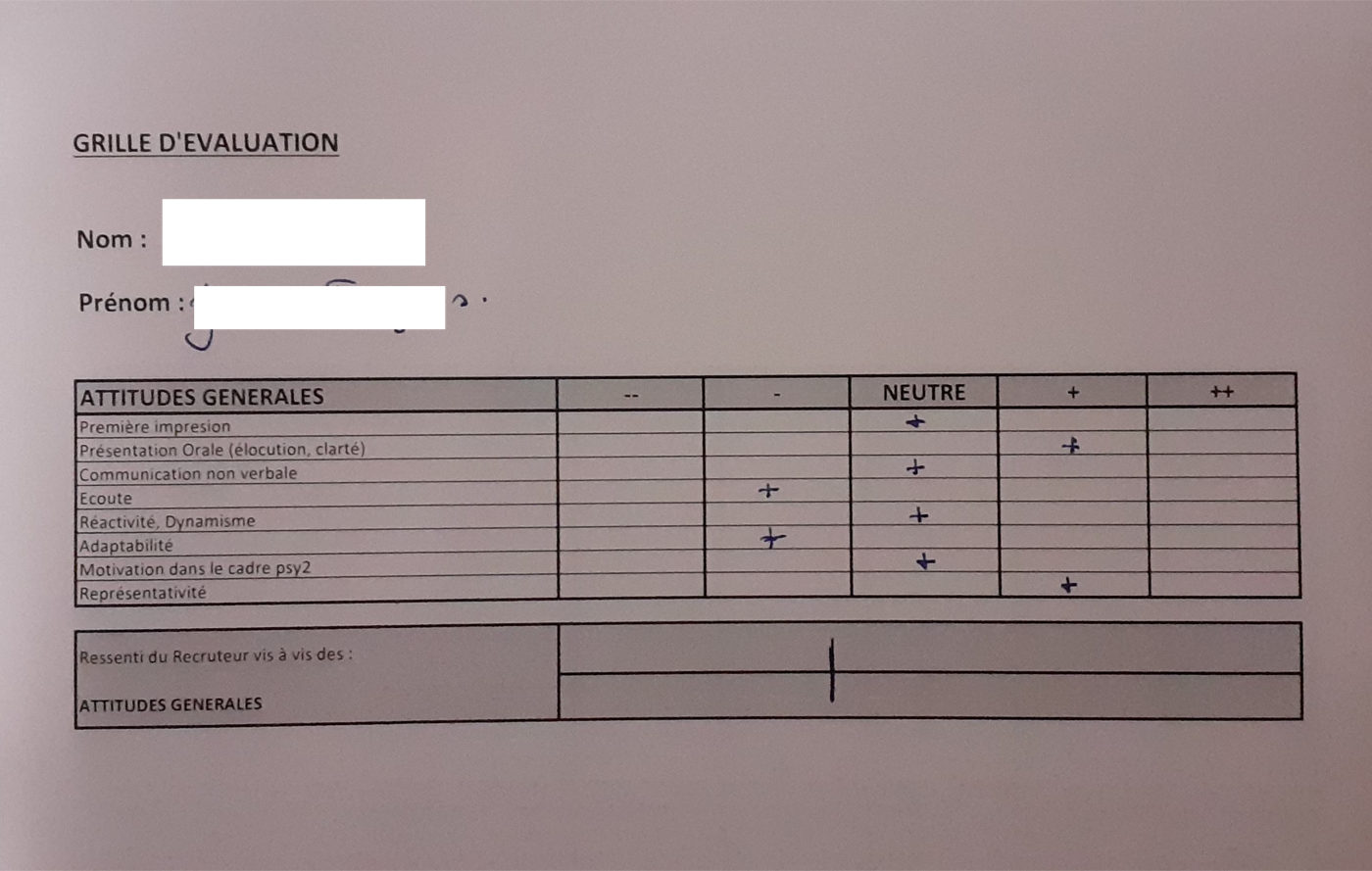
GENERAL ATTITUDE
This part is broader and no longer tied to the group exercise. It brings together the following:
First impression: the immediate image you give your recruiter.
Spoken presentation (delivery, clarity): how clearly and how well you express yourself, and whether what you say hangs together.
Non-verbal communication: everything your body language can be read to mean.
Listening: your general empathy and your attention to others.
Responsiveness and drive: are you sluggish or switched on?
Adaptability: your ability to be effective in a situation you did not see coming.
Motivation within the interview: how genuinely you want to get through this selection, and how determined you are to earn your place on the course or a career with the airline.
Representativeness: how far what came across during these interviews is authentic and true of you.
After the interviews, the board
Once your interviews are behind you, your recruiter gathers every element of your selection into your file: your results in the aptitude screening, the full test day, the interviews and, for experienced pilots, the simulator assessment. Each of those stages is given a colour, from red to green, quantifying the doubts it raised. A candidate marked green, green, amber, green is at risk of being turned down because of that amber at the interview stage. That is how the interviewer's verdict is coded, and it ranges across unfavourable, reserved, favourable with reservations and favourable.
Do keep in mind, though, how volatile a selection mechanism of this kind is. Air France itself recently compared this stage to a snapshot taken of the candidate. So if the photograph came out badly, it does not necessarily mean you are ugly. Perhaps you moved. Or perhaps your recruiter moved, or forgot to clean the lens.